When Lequeta and I stepped off a boat in Montenegro, we didn’t think we’d be pulled into an international spat.
But as we sat facing our driver, Goran, at a sidewalk café, that’s exactly where we were.
“Why?” he asked, looking at me for an answer. Then sounding more like a spurned lover, “Why him?”
Settling back in his chair with crossed arms, Goran smirked.
“We are a country of 600,000 people and most of us sleep until noon. How can we start World War III?”
That morning Lequeta and I watched our ship navigate mystical fjords leading out of the Adriatic Sea into the Bay of Kotor. Pine forests covered the mountain slopes that rose up on either side of us. Fishing villages and their boats, big and small, dotted the coastline as we sailed deep into this natural harbor.
We picked Goran from a queue of drivers in port. Possibly, because he reminded me of someone. His face was a roadmap of our European allies, complete with a Greek nose, Italian louche, and a Slavic accent. The beefy jawline, German car, and French cigarette gave him a slightly criminal, yet cosmopolitan air. But his Pacific Coast T-shirt, Raybans, and command of English said, “Welcome, America!”
“My family live here over 300 years!” he declared, pointing to the ground. “I charge you 60 Euros for a great tour.”
So we hopped into his Mercedes.
On our drive around the area, we talked about polite things – his work (two jobs), family (two children), local history (complicated), and current events (even more complicated). As a Social Studies teacher, Lequeta knew far more than I did about this region and its recent history – the wars, divisions, votes for independence, and the significance of Montenegro’s entrance into NATO. My knowledge was limited to the image of Donald Trump shoving their president aside for a photo op.
Goran navigated along a ridge road, driving us to a high point above the village. He found a perfect spot for pictures where we could see for miles; from the bowl-shaped coastline, back out through the gorge, and up and down the mountainside. Behind and below us the landscape was dotted with remains and re-do’s of medieval architecture; a mixture of old and new structures where nothing seemed out of scale. Crumbling remnants of a fortress wall outlined the city margins.
On the winding path back down, Goran’s narrated tour turned to his personal story. He talked about his stint in the merchant marines and the difficulty of life at sea. He talked about his wife’s work at a local hospital, and how their ten-year old son was working to buy an iPhone. He told us how fishing these waters had sustained his ancestors and was now his favorite pastime.
Back at the base of the mountain, Goran dropped us off for a short walk along the slim beaches.
As Lequeta and I strolled, it felt like we were walking through a movie set. Old buildings stood precariously close to the street, leaning into traffic. On the beach side, a narrow strip of sidewalk surrendered most of its space to vendors and artisans hawking their wares. Finally, we reached a strip of coarse sand where families clumped together around towels and umbrellas. Weekend sounds echoed between the hillside, the buildings and the water. Scooters and bicycles wove in and out of a slow line of cars. I inhaled the universal marina smell of water, gasoline, and fried fish. As Southeast Texas natives and experts on humidity, Lequeta and I agreed that Kotor must be one of the most humid places on earth.
We found Goran at the café where we now sat over coffee. Conversation came to a pause, and there was only the sound of the nearby mister, spitting a welcome cool. Goran surveyed our surroundings, waiting. A bell from the nearby cathedral pealed. There was nothing else to talk about except the inevitable.
“More coffee?” Goran asked.
We declined.
“Did you enjoy the walk?” he continued, stirring his coffee with a tiny spoon.
“Yes, we did,” I answered. “Your village is lovely.”
“Is there anything else you want to see? Or a boat ride?”
“No,” we shook our heads in unison. I was ready for the cool recesses of our cruise ship.
Goran leaned forward and, because I’ve traveled to 15 countries in the last 3 years and faced this inquiry nearly everywhere, when he said
“Can I ask you something?” I already knew the question.
“What do you think of Trump?”
As we’ve done for the past 56 years, Lequeta and I began to talk over each other, interjecting, gesturing, correcting, clarifying, disagreeing.
Fresh from a US History classroom and high on America, Lequeta used her teacher words, “His behavior! Well, I’ll just say . . . we are not all . . .“
“O Lord!” I interrupted. “No one thought . . . I mean — he had a reality TV show! And people were angry and frustrated. He was entertaining . . . and . . .”
Goran opened his hands, imploring, “Why did you elect him? “
“I DIDN’T.” l said.
Sensing where this was headed, Lequeta broke in.
“Now, I don’t think you ought to –”
“But I am!” I insisted. “I think people need to –”
“Well, I know, but I’m just saying . . . not . . . here . . .” as she gestured to our surroundings.
“I know, but I think it’s important,” I continued, as I saw Goran reach into his back pocket.
Perhaps trying to add fuel to the fire, he whipped out an iPhone where the infamous video was already queued up – a clip of Trump saying Montenegro’s aggression could start World War Three.
“Do you know what he said about us?” he asked, thrusting the screen forward.
Lequeta and I nodded, squinting at the tiny scene playing out in the Oval Office.
“Yes. We’ve heard about that.”
He smiled and rolled his eyes.
“We are a country of 600,000 people. Most days we sleep until noon. How can we start World War III? And why him? There were many other candidates.”
I cringed, remembering how the world watched our 2016 election process.
“People didn’t want to vote for Hillary.” I said, looking to Lequeta for backup.
“It’s true,” she agreed, “half our voters stayed home.”
And having just read the Mueller Report, I tried to shift blame.
“There were . . . others involved, too.”
Goran leaned back, crossing his arms and looking east toward the Balkans.
“Ah yes, we know about them,” he chuckled.
Montenegro understood complicated relationships. Its very existence was due to a breakup. Russia had skulked around this neighborhood for decades, offering fancy missile systems, vodka, electoral “assistance,” and the promise of a meaningful – if sometimes abusive – relationship with someone closer to home.
Which was why NATO membership mattered to Montenegro. What America and Europe offered was something different: protection through an alliance. One the US helped establish and nurture with other free countries, knowing we had each other’s backs – like after 9/11. But Montenegro had only recently joined. Now the US was saying it needed more time, more space, more money from the relationship. Also, we might not answer when they call for help. Goran’s country felt jilted.
Of course, we hadn’t broken up with our allies in the classic sense. We’d just taken a break – from the messiness, the Brexit drama, the money fights, the obligations. In a reversal of the tired old breakup line, the United States told NATO, “It’s not me, it’s you.”
Lequeta broke the silence.
“America is a great country. We don’t always get things right, but we try. And I believe in our institutions.”
“We’ll vote again,” I said. “Just watch.”
Goran scooted back his chair,
“I don’t vote. The elections? Every. Four. Years.” he said, dismissing it with a wave. “There’s too much chaos. I don’t vote.”
Lequeta prickled.
“We sure do,” she said, “Well, most of us.”
He gestured toward the car.
“Are you ready?”
Conversation turned to lighter fare on the short drive to our boat. We told Goran we had a quick stop in Albania before going to Greece. He assured us Montenegro was much prettier, the people nicer. His next stop would be the marina, for fishing.
Back at the dock, we asked for one last picture before saying goodbye.
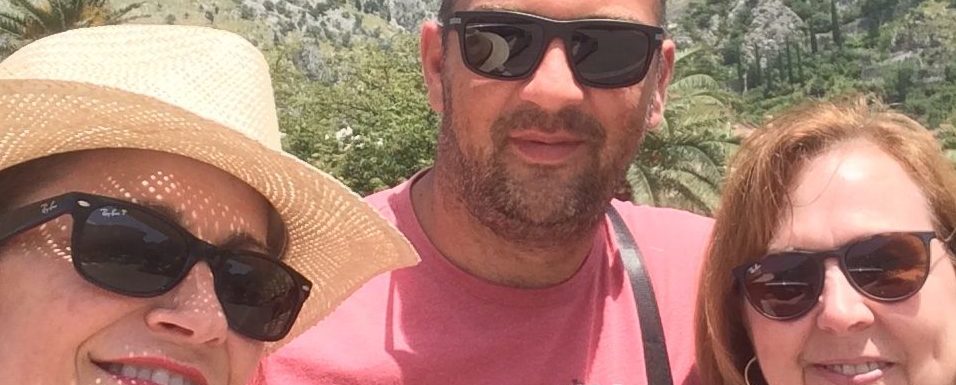
“Ah, the selfie,” he laughed, as we all leaned in, smiling. With the black mountains of Montenegro behind us, I snapped a picture.
“Come back sometime,” he said, as we turned to leave. “I will show you more of our beautiful country.”
Later, in the cool recesses of our ship’s lounge, Lequeta and I rehashed the day’s events and toasted friendships, old and new.
We marveled that in our combined travel experiences we find a warm reception in most places, probably because of US aid and defense of these countries over time – whether at Normandy, in the Balkans, or through networks of global relief organizations. People speak our language and smile at our American dollars. They ask questions about our culture, politicians, guns, movie stars, and food. And they appreciate honest answers.
Conversation circled back to our earlier disagreement. Lequeta reiterated her stance that we shouldn’t criticize our government abroad. I was equally dug in about the need to apologize for dangerous US foreign policy. Though I agreed it was silly to moan about our domestic woes – especially in a region with fresh scars from civil war and ethnic cleansing.
We moved on to our final revelation of the evening which was something we agreed on. As citizens of the world’s only remaining superpower and one of the world’s largest democracies, our passports come with rights and responsibilities. That day both mattered to us. I had exercised my right to criticize our government, and Lequeta fulfilled her responsibility to defend it.