 Faces of Diplomacy
As the Tehran hotel elevator whooshed closed, it dawned on me. The man escorting me upstairs was a member of the Iranian police force.
I felt beyond foolish. It was the Spring of 2016 and thawing relations between our countries piqued my interest. Recent news articles described the safety and ease of travel to Iran. As long as tourists behaved, it was one of the safest places in the region. Despite news clips of bearded men shouting “Death to America,” the lure of an ancient culture, twenty one World Heritage sites, and the Persian reputation for hospitality were too much to pass up. Besides – I heard they secretly liked us.
Now this young man and I faced each other, using elevator etiquette. I stole a glance — jet black hair, thick, bushy brows meeting in the middle, prominent nose, light brown/golden eyes, so common in this region. Trying to avoid eye contact, I looked at the door, the floor, the emergency button, my shoes, his boots. Then realized the drab olive shirt and pants I had mistaken for a bellman’s ensemble were a different kind of uniform. The epaulets, the utility belt with various pouches, the spit shined boots and, finally, the gun, added up to something else that made my gut tighten. He was a policeman.
The World Affairs Council mailer advertised a ten-day trip. It invited travelers to visit Tehran, Shiraz, Esfahan, and Persepolis, the ruins of an ancient ceremonial complex. I applied for a visa and filled out a resume, listing my interest in Iran and describing my work and (as the travel agent warned) leaving out anything related to writing, reporting, or journalism. I crossed out mention of my research for a memoir exploring religion’s role in social change. For this trip I was Kay Dial, a former school nurse with a yen for exotic travel.
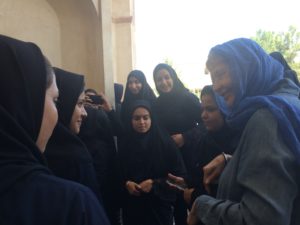
The first part of this journey went off without a hitch. Our hotels were contemporary palaces with large rooms and courtyards full of fragrant orange trees. BBC played on the television. Breakfast buffets were stuffed with offerings from around the world, including grits and “Western Omelets.” We toured mosque after mosque and bazaars and restaurants, where people smiled, taking our American dollars. We were shocked at museum encounters with groups of school girls who surrounded us, jostled for selfies, and flashed the universal “peace” sign as they bombarded us with questions in English. And though we’d been warned to avoid the topics of politics, religion, or anything remotely personal, we fielded queries from strangers, hotel and restaurant employees, and a random fellow on the street demanding to know,
“Who will win? Hillary or The Trump?”
Maybe I’d been lulled into a false sense of security. This evening I walked down to the hotel “bar” where, like anywhere else in the world, men and one or two adventurous women gathered to play pool, watch soccer, and sip non-alcoholic beer. This was, after all, the Islamic Republic.
When a broken keycard sent me to the desk for a replacement, the desk clerk was friendly, fluent in English, and ready to talk.
Was I familiar with the author Thomas Pynchon?
What did I think of their leaders?
Did I agree with the sanctions?
And while I knew that decades of increasing sanctions were exactly what brought Iran to the bargaining table, forcing them to curtail their nuclear ambitions, I answered carefully and quickly changed the subject.
As we talked, I didn’t notice that the bellman left his post at the hotel door, ambled over to the desk, and began listening. But as the clerk reached out with a new key card, the bellman grabbed it and, with a tight smile and a nod, turned to face me.
The clerk held his hand, palm up, entreating.
“It’s nothing,” he said. “Her key broke.”
And then I saw the look between them.
It was the “C’mon man” look, a silent appeal or bid between men or boys. A weak and usually impotent gesture, often displayed trying to stop an episode of bullying or predatory behavior. But the bellman ignored the bespectacled desk clerk, gave me a nod, and extended his hand toward the elevator as if to say, “let’s go.”
Our travel agent had been optimistic that successful trips like this would lead to greater understanding and positive change. And our local tour guide assured us the Iranian people (or Persians, as they prefer to be called) weren’t highly religious. Most of them aren’t even observant Muslims, he told us. So I enjoyed the outpouring of hospitality, the desert fortresses, and the archeological digs; relics of this once-great empire.
When the elevator dinged and the door slid open, we made eye contact. Expressionless, he motioned for me to go first. I stepped out and turned right, my mind racing. What had I done? Did they Google me? Had they seen my social media posts about writing? Did they know I’d been reading the Dallas Morning News on my iPhone?
We walked past the rooms of my fellow travelers: Allen, a former Shell executive, Ann, a wiry 75 year old, recently back from Antarctica, and Jack, the U.S consulate to Ghana who once served as Clayton Williams’ campaign manager. Would he advise me to “relax and enjoy” whatever was about to happen? Had this soldier seen something on my resume that made him pull me aside? If I screamed, would anyone hear me?
I stopped at my room and stood frozen as the young man inserted the key card and the light flashed green. He opened the door and waved me in. I crossed the threshold, then turned and saw he had stepped back, so I started to close the door, mumbling, “Thanks.” But he reached out, holding it open as he pointed at me and said,
“DocTOR.”
“No!” I said, shaking my head.
He paused, then pointed again, insisting,
“DocTOR!”
“Well,” I said, “I’m a nurse . . .”
and then, God knows why, repeating in Spanish,
“Enfermera.” “Yes, I’m a nurse!”
I knew it was safe to admit this because my resume had listed nursing experience, from ICU through a long stint as a school nurse, wrangling thousands of kids, including special needs students.
At which point he reached around to his back pocket, past the gun on his hip, past the handcuffs tucked into his belt, and whipped out an iPhone. He held one hand up in the universal “Wait” signal as he tapped and scrolled down the screen. Then, making eye contact, he handed me the phone, where I saw a picture of him in miniature. A three or four-year-old boy with the same hair, same gold-flecked eyes and a hint of his dad’s unibrow. He wore shorts and a shirt in primary colors and sat on the end of a playground slide, smiling. But the preschooler’s features were different. His round face and almond shaped eyes with their distinct folds told me he had Downs Syndrome.
Reflexively, I smiled, mirroring the happy boy.
The young man waited for my reaction.
“He looks good! Very healthy!” I said, pointing at the phone.
And then, flexing my arm and offering Spanish, “Fuerte!” (strong).
“Your son?” I asked, handing the iPhone back.
He nodded yes, looked down at the picture, and put the phone over his heart, a gesture I’d seen time and time again here, showing sincerity.
Without thinking, I put my hand over my heart, too,
“Thank you.”
He stepped back and bowed slightly, then turned and walked away.
I closed the door and locked it; exhaling with a small laugh. Death to America, my ass. I just made a new friend.