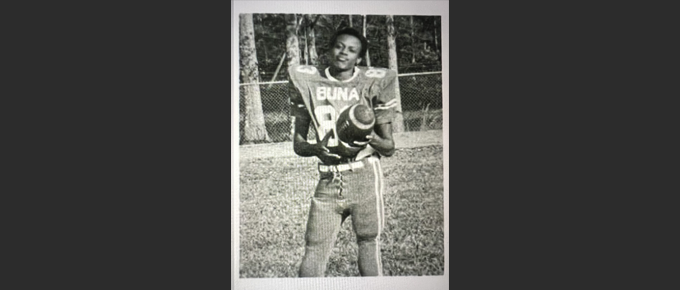
Jessie Kibbles was born to run. Genes gave him a long-limbed stride. Time and place gave him motivation. As a fellow student and editor of the yearbook’s Sports section, I had a front row seat to Jessie’s rise through athletic programs in our hometown. A few years ago, he told me about a pivotal event during his childhood.
Buna Independent School District combined its White and Negro schools in 1965. Jessie and his schoolmates transferred from their Bessmay neighborhood campus which was known as the Negro school. They joined my White classmates and me at Buna Elementary in a traditional red brick building.
According to federal guidelines, we shared facilities and activities. But community integration wasn’t easy, and it didn’t happen all at once. Over the next few years public pools in the area closed rather than allow Black children to swim. And in 1970, Buna’s skating rink was still “Whites Only.”
That’s why, one spring evening in 1970, Jessie stood outside the skating rink instead of inside. The rink was a seasonal business near Buna’s Little League Park. Its hardwood floor and canvas tent went up in two days each fall and came down just as quickly when crowds waned in summer. After baseball games, kids hung out in the parking lot, re-telling the game, laughing, and enjoying the fellowship of team sports. But the parking lot acted as a filter. When clumps of boys moved from the baseball park toward the rink, Jessie and his Black teammates stayed behind. Only the White ones entered.
Pop tunes and Motown blared from inside, mixed with the sounds of fun — laughter, the roar of rolling skates, stomping with the beat. This felt like picking at a scab on Jessie’s soul.
He had suffered the previous two years. His father, Jessie Kibbles, Sr., died shortly before Christmas in 1968, and poverty engulfed their family. Two sisters went to live with relatives in Louisiana. Jessie and his brothers remained with their mother, who had recently remarried. Adverse experiences like this — death of a parent, loss of siblings, poverty, and discrimination — often derail a child’s life unless something softens these blows.
According to Jessie, his father’s death had already triggered a community response.
“A group of White men from Buna’s Methodist church responded to our family tragedy with an act of grace. They invited my brother and me into Little League and Boy Scouts.”
This group paid fees and gave them rides to and from meetings and games. It was during this time Jessie first began competitive running and how he came to mingle with White teammates outside the skating rink.
On that spring night in 1970 there was no sense hanging around, so they walked away from the rink toward Bessmay, but — typical for boys at that time — someone had a bottle rocket, which he lobbed as a parting shot toward the big tent.
When a loud bang rattled the skating rink, smoke and a sulfuric smell spread through the air. The music stopped. Skaters streamed outside, alarmed at the noise, looking for the source — and saw a group of Black teens walking away.
An angry crowd gave chase on foot and in cars. The boys split up, with some cutting through a pasture on their way to Bessmay. Jessie took refuge in nearby bushes.
“I hadn’t done anything. I didn’t think I had anything to fear. After a few minutes things settled down, so I stepped out and started walking again.”
He hadn’t gone far when a sedan skidded up in a hail of gravel and dust. As it slowed a back door flew open, nearly swiping Jessie. A teenage boy leaned out; his face twisted in grimace.
“Get in the car, N****r!”
“I didn’t do anything!” Jessie protested.
The boy repeated, “Get. In the car, N****r!”
Fifty years later as Jessie recalled details, he paused, tenting his fingers, “This may be where the fast come from.”
Jessie left the road, ripping through the woods, a tangle of low-lying limbs, knee high weeds, and briars. As the landscape tore his flesh, he focused, numb to pain, and ran his fastest half mile ever.
Jessie collapsed on the front porch where his mother found him, breathless; covered with scratches and debris. The story spewed out in a torrent of tears, and he’d no sooner finished recounting the ordeal than Deputy Sheriff Carlton Cook arrived.
His mother stood as Cook exited the police cruiser.
“I’m going to have to take your boy to jail,” he said, pointing at Jessie.
She shook her head,
“You will not take my son!”
By this time her husband had stepped to the door. Cook repeated himself and added,
“He tried to blow up the skating rink! I have to take him in.”
“You will not take my son! Look — look at what they’ve done to him! You need to go talk to the people who started this!”
She pointed at Jessie — leaves and twigs stuck to his clothes, fresh scratches welling up on his arms and face — then described the torment and harassment he’d experienced.
Her husband tried to stop her. This was a dangerous way for a Black woman to talk to law enforcement — but she forced Deputy Cook to listen as she argued her son’s case, naming names and listing offenses.
“Go get the White boys who’ve been chasing our children like animals!”
Cook had experience with the racial hatred and bigotry of the era. Four years prior he faced down an armed mob of Ku Klux Klan members in the middle of town demanding that a Black prisoner be handed over to them. The Deputy refused and ran the Klansmen out of town. Since then, he’d faced scores of dangerous people and often walked a tightrope between the Black and White communities. Today, he faced Earline Kibbles and her child.
Though he’d come to take Jessie, Carlton Cook changed his mind; a decision with ramifications that extended beyond Buna.
An African proverb says it takes a village to raise a child, and over the next few years our village encircled Jessie. He felt loved and nurtured at home. A team of coaches, teachers, and community volunteers guided him on the field and in the classroom. While he occasionally endured taunting and felt the sting of racism, more often, he saw loyal friends and classmates celebrating his success.
Before graduating from Buna High School, Jessie set two state records in Track and Field. He won a football scholarship to Lamar University, where he earned a Master’s Degree in Education and was inducted into Lamar’s Hall of Honor. Near the end of his long career as a teacher, principal, and administrator in Beaumont ISD, he took a job that brought him full circle with law enforcement. He became Beaumont’s Director of Alternative Education Programs and went to jail every day, teaching incarcerated teens. Today, he directs the Alternative Education Program at Buna’s Junior High School.
Along with his success and acclaim, Jessie carries a vivid memory of that day in 1970 – the sense of terror, his mother’s fierce love, and how running saved him. He also grew to understand the importance of community. And he knows that as surely as fear and hatred set him running, love kept him going.